Hey Ho!
Hope you all are safe and well! Welcome to a life hack post.
Introduction
For most of my adult life, I have struggled to wake up in the morning. I would want to get up early and start the day right. Would set the alarm early with lofty hopes of great things that I am going to accomplish the next morning. But, inevitably there would be the snooze-war between me and my alarm.
My laziness will win.
I will sleep in.
The guilt would seep in.
And I would keep the mistake repeating.
(ignore my haiku attempt).
Point is, after years I just kind of resigned myself to waking up late. And even rationalized that I am a late-raiser. But, about 3 months ago, I accidentally stumbled upon this gem of a podcast. It is from Alex Huberman, a neuroscientist and professor from Stanford University. I am devouring the entire series, highly recommend it.
And in this post, I wanted to summarize two easy methods he proposes to wake up in the mornings automatically. I ran that science experiment on myself for the last 3 months. And it works like a charm folks!
I have been waking up now without an alarm for the last 2 months between 6 am and 6:30 am. It’s become a habit, so I can personally vouch for it. If you are facing the same problem as I did, buckle up! We got some fun science to learn and implement.
Background
Before we jump into the two methods, let’s quickly look at how your body works (this is a simplified version, for the full version check out Dr. Alex Huberman’s podcast). Your body has a mechanism to keep track of its internal 24-hour clock. And it accomplishes this using a bio-molecule-stuff that rises and falls in the 24-hour cycle.
The key thing to remember is that it is periodic.
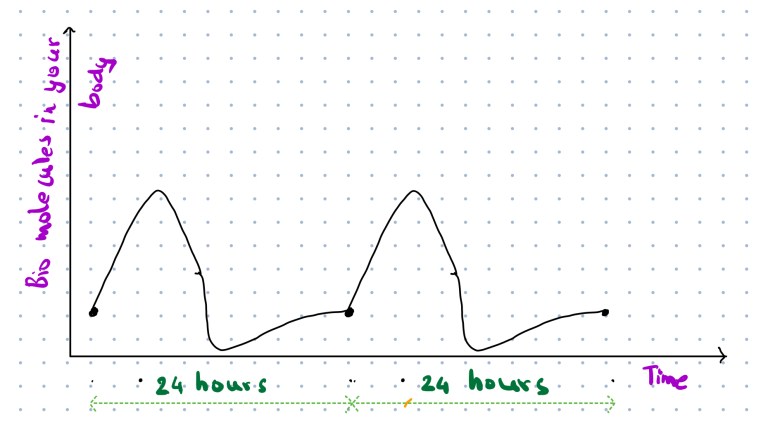
There are bio-molecule-stuff inside your body that helps your body keep track of its internal clock.
As you might have guessed, there are not one but many bio-molecules that help with keeping track of the internal clock. Millions and millions of them.
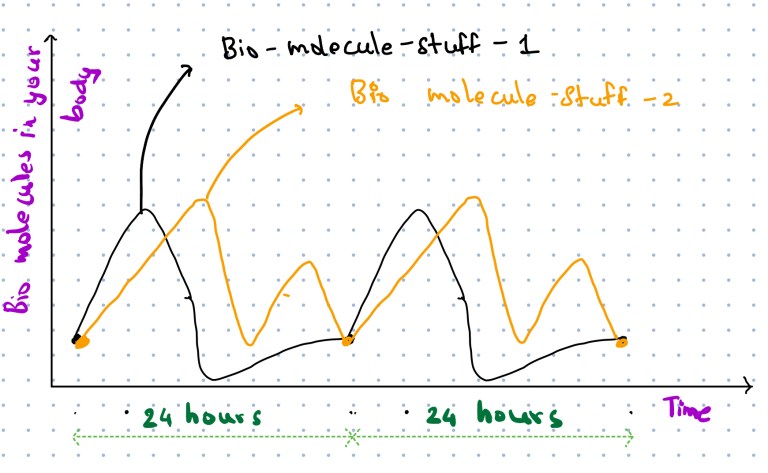
There are multiple bio-molecule-stuff inside your body that help you keep track of them.
The raise and fall of this curve is an internal timetable for the body. Using these, it knows when to trigger certain actions inside your body. For example, things like hunger, thirst, sleep, wake-up and so on.
For now, we are going to focus only on the bio-molecules for the wake-up part. Specifically, two bio-molecules.
Waking up
There are multiple periodic triggers from bio-molecules that tell your body when you have to get up. And within wake-up, we are going to focus only on two specific periodic triggers because they are easy to understand and also easy to control.
1. Photoreceptors inside the eye
There is a magic that happens between your eye and, ONLY with, sunlight in the early morning (5 am to 7 am). There are very specific photoreceptors inside your retina built purely for this sunlight at this time. Basically the receptor, and consequently the molecule it triggers, keeps track of the wake-up cycle. It goes up, and tells your body it’s time to wake up.
Prof. Alex Huberman recommends at least 20 minutes of exposure. It does not work if you get the sunlight through a transparent window. You need direct exposure to that sunlight.
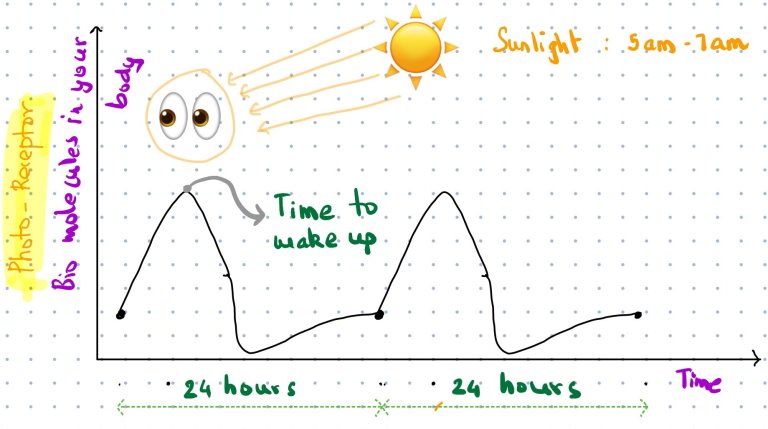
Bio-molecule stuff triggers for the specific photoreceptors dedicated to early sunlight.
Now here is the awesome part!
Keep doing this for a while, your body learns the cycle. And then it goes into a learned prediction mode. It automatically secretes these bio-molecules ready to receive the sunlight. And that is what makes you wake up automatically. Isn’t that magic!?
For example, I noticed that in my case. I had to force myself to get the sunlight exposure for about 10-12 days at about 6 am. After about 3 weeks, I automatically had this “urge” to wake up at this time. The “urge” comes from the molecules secreting on their learned prediction cycle and waiting for the sunlight. The habit reinforces itself.
Important stuff from Prof. Alex Huberman:
- Get direct sunlight exposure. Not looking through a glass window.
- Get at least 20 minutes of exposure.
- Don’t worry if it’s not “sunny”. Even on the cloudiest or darkest of days, there is enough lumen brightness to trigger the photoreceptor in your eye (nature is awesome!).
2. Sweat it out in the morning
The other thing Huberman recommends is to get your body moving at least for 20 minutes right after you wake up. This could be any kind of exercise you like. Running, walking, or anything you like! I will skip the specifics. But it’s very similar to the above. Specific bio-molecules get triggered at this time when you move and signal your body to wake up.
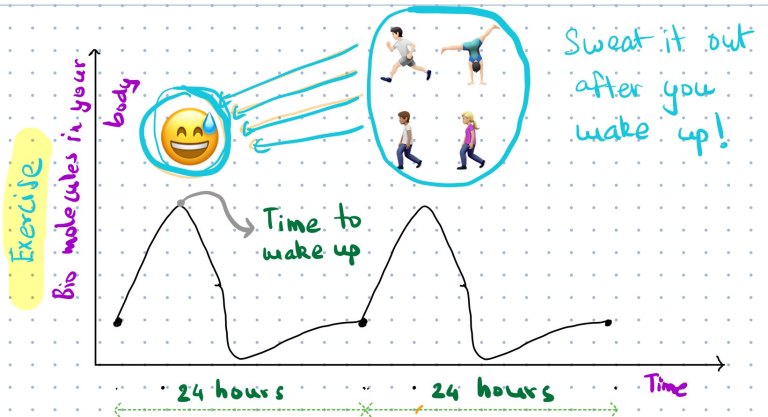
Bio-molecule stuff triggers for exercise.
Do this enough number of times (2 weeks or so). Then your body again goes into a learned prediction mode for this specific “exercise” bio-molecule. Again, you will automatically get the “urge” because the body has learned to secrete it and is ready to “receive” exercise.
Important stuff from Prof. Alex Huberman:
- It does not matter what kind of exercise you are doing.
- As long as you are moving your body and slightly sweating out your body, it should be fine.
- A simple brisk walk works too.
Adi’s personal recommendation
Apart from the above two, there are several other hacks you can learn from here.
Although, I played around with the others, these two were the most practical, simplest and gave the best results. I can promise it works from my own personal experience. I actually try to combine them both in a single 20-minute routine. I go for a run right away for at least 20 minutes right after I wake up. Even before I brush my teeth or so. I get my sunlight exposure and I also squeeze in my exercise routine in the same run.
Sometimes “will-power” is not enough to modify your behaviors. When you understand your body, apply seeming easy hacks, it just works like magic. To be honest, I was quite surprised by the results. Because I had been struggling, and kinda feeling guilty for a long while, about this late raising habit of mine.
I had to struggle for the first two weeks to wake up early. But now it’s on auto-pilot! Whether I am moving countries, traveling, or whatever life throws at me. The body is doing its magic 😅 and I get up every single day at around 6.30ish.
I also quite like this early morning me time. But that is for another blog post 😉.
Conclusion
- We learned how the body keeps track of its internal clock.
- We specifically focused on the wake-up clock.
- We looked at two hacks on how we can resynchronize this wake-up clock, and how we can wake up automatically without an alarm.
- The first 2 weeks are the hardest, and then the body works on learned-prediction autopilot.
Hope that helps someone who is in the same boat as I was 🙂
Subscribe
Please SUBSCRIBE if you would like to be notified when such posts come out. Also, if you find this helpful, please share it with your friends and family. As of now, there is no monetary angle to this blog. More audience encourages me to keep writing such useful content. Thanks, folks. Until the next time, Ciao!